
Learn Khmer: a practical course for expats and travellers
You do not need to be fluent to make a trip to Cambodia noticeably better. Start with practical lessons on greetings, money, food, getting around and everyday phrases; new lessons are added over time.
Updated 20 Oct 2026
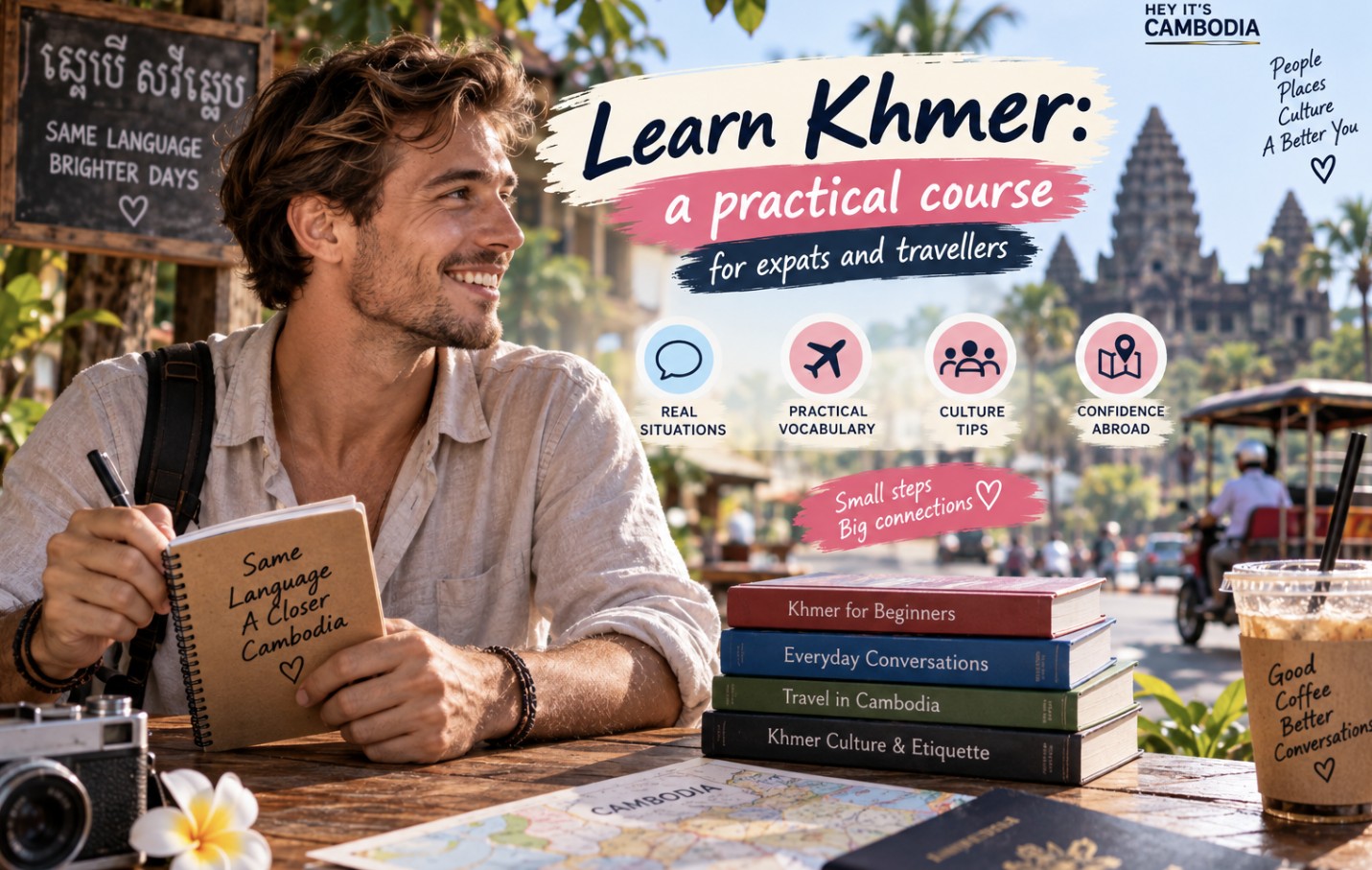
Khmer looks intimidating on paper: its own script, no shared vocabulary with English, six vowel-length distinctions native speakers barely think about. The good news: you do not need any of that to get real value out of a few words. Cambodians notice and appreciate a visitor who tries, even badly, and a handful of phrases will smooth out tuk-tuk rides, markets and restaurant orders every single day of a trip.
This growing course is built for that goal specifically: not academic Khmer, just the words that get used constantly by an English-speaking tourist or new expat in Phnom Penh. Every lesson is short enough to read once before you go out, and every phrase is written phonetically first, so you do not need to read the Khmer script to use any of this.
Start with these lessons
- Lesson 1: Greetings and politeness: the words you will use in literally every interaction, plus the gendered polite particle that instantly makes you sound better.
- Lesson 2: Numbers and money: counting to a hundred, reading a price, and the handful of phrases that help at a market.
- Lesson 3: Ordering food and drink: enough to order confidently, ask for less spice, and pay the bill.
- Lesson 4: Getting around: tuk-tuks, directions and the phrases that stop a driver overcharging or overshooting your stop.
- Lesson 5: Everyday survival phrases: the catch-all lesson, covering understanding, apologising, small talk, and what to say if something goes wrong.
How to actually use this
Do not try to memorise everything before landing. Read Lesson 1 before your flight, then work through one lesson a day once you are here. New practical lessons will join this course over time; each one is written to be usable within minutes, not studied for hours. Say the words out loud, even quietly to yourself first; Khmer pronunciation is unfamiliar but not hard once your mouth has tried it.
A few honest notes before you start
- Tones don't exist, but vowel length does. Unlike Thai or Vietnamese, Khmer is not a tonal language, which makes it more forgiving for a beginner. It does distinguish short and long vowels (the difference between knom and knohm, roughly), but native speakers will understand you from context even if you get this slightly wrong.
- Romanisation varies. There is no single official way to spell Khmer sounds in Latin letters, so you will see the same word written two or three different ways across guidebooks and apps. That's normal, not a mistake; say it out loud and people will understand.
- English gets you further in central Phnom Penh than in the provinces. Staff at restaurants and hotels in BKK1 or Daun Penh often speak good English. A few words of Khmer still change the tone of the interaction, reading as respect rather than necessity.
Ready? Start with Lesson 1: Greetings and politeness. Return here as the course grows, and once you are hungry to practise ordering for real, the Khmer & local list and the full Phnom Penh directory are good places to go try it out.