
Khmer Lesson 5: everyday survival phrases
The catch-all lesson: saying you don't understand, apologising, small talk, and what to say if something actually goes wrong.
Updated 20 Oct 2026
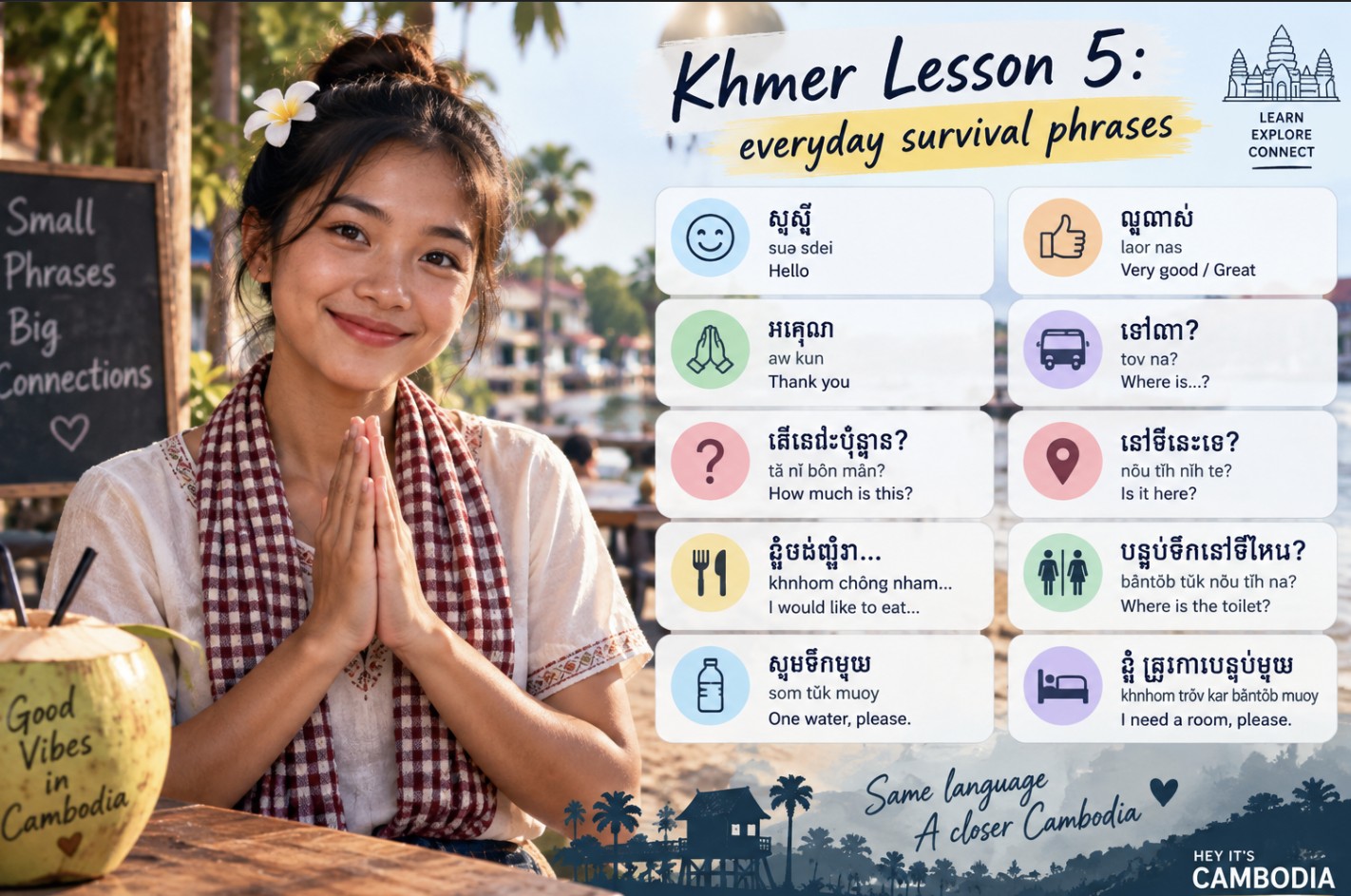
Part of the Khmer course for expats and travellers. Previous: Lesson 4: Getting around. This is the final lesson for now.
The first four lessons cover greetings, money, food and transport, the situations you can plan for. This last lesson is the safety net: the phrases for when you don't understand something, need help, or just want to make small talk. Keep this one closest to hand.
When you don't understand
- I don't understand: khnom min yol te (“k'nyom min yol tay”), the most useful phrase in this entire course. Say it and people will slow down, simplify, or switch to gestures. Picture shaking your head “no” while yelling “min? Yo!” across the room, min as in you missed a minute of the conversation.
- Do you speak English? nak jeh phiasaa angleh te? (“nay-ak jeh p'yea-sah ong-glay tay”).
- Please speak slowly: som niyeay yeut yeut (“som nee-ay yoot yoot”).
- Can you repeat that? som niyeay m'dawng tiet (“som nee-ay m'dong tee-et”).
Politeness and small talk
- Sorry (apology, not “excuse me”): som toh, the same phrase from Lesson 1 also works here.
- What's your name? neak ch'muah ei? (“nee-ak ch'moo-ah ay”).
- My name is...: khnom ch'muah... (“k'nyom ch'moo-ah”).
- Where are you from? neak mao pi prateh naa? (“nee-ak mao pee pra-tay nah”), a common, friendly question you'll be asked constantly; useful to be able to ask back.
- I'm from...: khnom mao pi... followed by your country's name (often understood in English even in a Khmer sentence).
If something goes wrong
- Help!: juay khnom phawng! (“joo-ay k'nyom pong”). Picture shouting for a DJ to stop the music, “joo-ay!”, because something's gone wrong.
- I'm lost: khnom vong veng (“k'nyom vong veng”). Picture wandering in vague, aimless circles (vong veng sounds like “vague” twice).
- Where is the toilet? bawngkuon nov ei naa? (“bong-koo-on nov ay nah”), genuinely one of the most-used travel phrases in any language. Picture banging on a bathroom door, “bong-koo-on!”, hoping it's free.
- I need a doctor: khnom trauv kaa kru pet (“k'nyom trow kah kroo pet”).
- Call the police: hav polis (“hav poh-lees”), understood as-is; Cambodia's tourist police in central areas often speak some English too.
Putting these lessons together
You now have enough Khmer to greet someone properly, understand a price, order a meal the way you actually want it, get a tuk-tuk to where you're going, and ask for help if something goes sideways. That is a genuinely useful, practical toolkit: not fluency, but enough to make every day of a Cambodia trip smoother and warmer.
The best way to keep it is to use it: order your next meal entirely in Khmer from Lesson 3, or negotiate your next tuk-tuk fare with Lesson 4. Missed a lesson? Go back to the course overview to pick up where you left off.