
Khmer Lesson 2: numbers and money
Counting to a hundred in Khmer with a vivid memory trick for every digit, a full tens table, reading a price out loud, and the phrases that actually help at a market or with a tuk-tuk fare.
Updated 20 Oct 2026
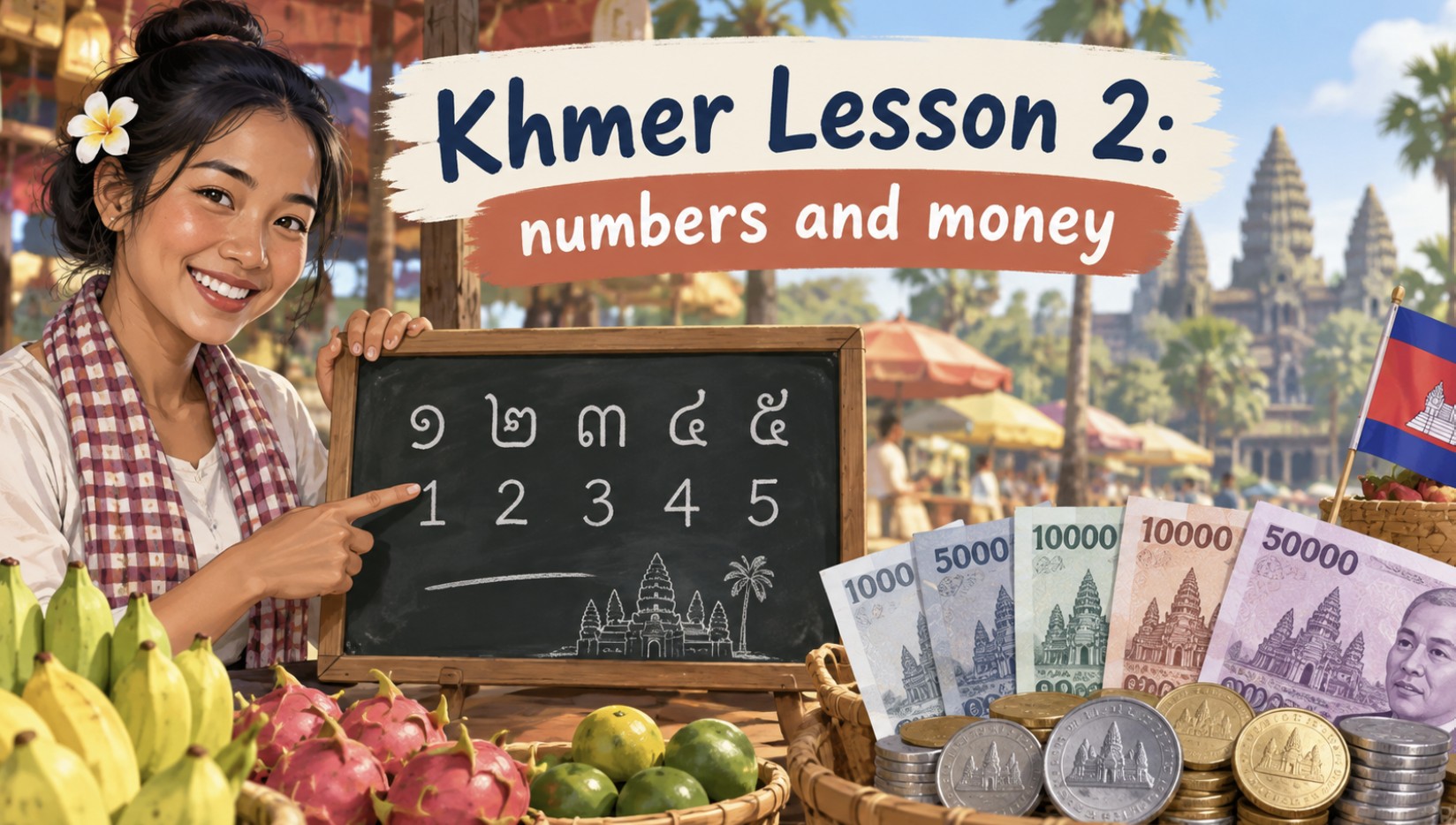
Part of the Khmer course for expats and travellers. Missed the first one? Start with Lesson 1: Greetings and politeness.
Cambodia runs on two currencies at once: US dollars for most prices, Cambodian riel for the small change underneath a dollar (roughly 4,000 riel to US$1). Of everything in this course, numbers are the one piece of Khmer you cannot get away with skipping. You will not survive a single market stall, tuk-tuk ride or phone number without them, but here's the good news: the whole system is a five-word Lego set, not a hundred words to cram.
The five building blocks (1 to 5)
Learn these five properly and the rest of the number system builds itself. Each one gets a small, slightly ridiculous mental picture, and ridiculous is the point: a strange image sticks far better than a word repeated ten times.
| Number | Khmer | Say it | Picture this |
|---|---|---|---|
| 1 | muy | “mooy” | A lone cow in an empty field, mooing at nobody. One cow, one muy. |
| 2 | pii | “pee” | A restroom door marked “P”, always paired with another one right beside it. Two doors, pii. |
| 3 | bei | “bay” | Three little fishing boats bobbing into a quiet bay. Three boats, one bay, bei. |
| 4 | buan | “boo-an” | A wobbly table finally staying buoyant and level on all four legs. Four legs, buan. |
| 5 | pram | “pram” | A hand slamming down for a high-five with a satisfying “pram!” slap. Five fingers, pram. |
6 to 10: no new words, just addition
This is where Khmer stops being scary. Once pram (5) is in your pocket, 6 through 9 cost you nothing extra: say pram, then bolt the right small number onto the end. It is the same high-five, holding up one, two, three or four more fingers.
| Number | Khmer | The logic |
|---|---|---|
| 6 | pram muy | “5 + 1”: your high-five, plus the lone cow. |
| 7 | pram pii | “5 + 2”: your high-five, plus the two restroom doors. |
| 8 | pram bei | “5 + 3”: your high-five, plus the three fishing boats. |
| 9 | pram buan | “5 + 4”: your high-five, plus the four table legs. |
| 10 | dawp | “dop”: two hands meeting in one big clap, all ten fingers at once. |
Say the full run, 1 to 10, out loud two or three times. Then try it backwards from 10. That reverse pass is usually the exact moment the numbers stop being a list you're reciting and start being something you actually know.
The tens: 10 to 100
Khmer's twenties are the one genuine exception in an otherwise tidy system, so learn m'phei as its own word rather than trying to derive it. Everything from 30 onward snaps back into the pattern: the tens digit, then sep (“ten”).
| Number | Khmer | Say it |
|---|---|---|
| 10 | dawp | “dop” |
| 20 | m'phei | “m'pay” (irregular, just learn it) |
| 30 | saam sep | “sahm sep” |
| 40 | saai sep | “sigh sep” |
| 50 | haa sep | “hah sep” |
| 60 | hok sep | “hok sep” |
| 70 | jet sep | “jet sep” |
| 80 | paet sep | “pite sep” |
| 90 | kau sep | “kow sep” |
| 100 | muy roy | “mooy roy”, literally “one hundred” |
Slot anything in between by simply adding a digit from your five building blocks: 45 is saai sep pram (“forty, five”), 72 is jet sep pii (“seventy, two”). Same pattern every time, no exceptions once you're past twenty.
Money-sized numbers
Once you're past a hundred, Khmer keeps stacking the same way: muy poan is one thousand, which matters daily since almost every riel price you'll actually meet is quoted in the thousands. Handy anchor: a US$1 note converts to roughly buan poan (four thousand) riel, the same buan (4, the wobbly table) from before, so it costs you nothing new to remember.
Money phrases that actually help
- How much? t'lay ponmaan? (“tlai pon-mahn”), the single most useful phrase in this entire lesson.
- Expensive: t'lay (“tlai”). Said with a smile and a small pause, this alone often earns a better price at a market.
- Can you reduce it a little? joh tit baan te? (“joh teet ban tay”), the standard, non-confrontational way to ask for a small discount.
- Do you have change? mian luy sae te? (“mee-an looy sai tay”).
- It's fine, no need: ot ei te (“oht ay tay”), useful for politely declining a persistent seller.
Reading a price in practice
If a vendor says muy roy for something priced in riel, that's “one hundred”, almost certainly meaning 100,000 riel (about US$25), since riel prices are usually quoted in thousands with the word itself left unsaid. Context and a glance at the item will usually clear up which; if you're still not sure, ask t'lay ponmaan? again and let a raised set of fingers or a phone calculator settle it, which is completely normal practice here, not a fallback for people who've failed at Khmer.
A market-haggling script, start to finish
Put the whole toolkit to work: point at the item, ask t'lay ponmaan?, hear the price, respond t'lay with a smile, then try joh tit baan te? Most casual market haggling in Cambodia is warm and low-stakes, a small, good-natured back-and-forth rather than a battle. Treat it as a tiny piece of theatre both sides enjoy, and you'll fit right in.
Next: Lesson 3: Ordering food and drink, so you can put those numbers to use over a meal.