
Tuk-Tuk vs Car for Angkor Wat: Which Is Better?
Compare tuk-tuk and private car for Angkor Wat by comfort, cost, heat, families, sunrise, Small Circuit, Grand Circuit and longer temple routes.
Updated 20 Oct 2026
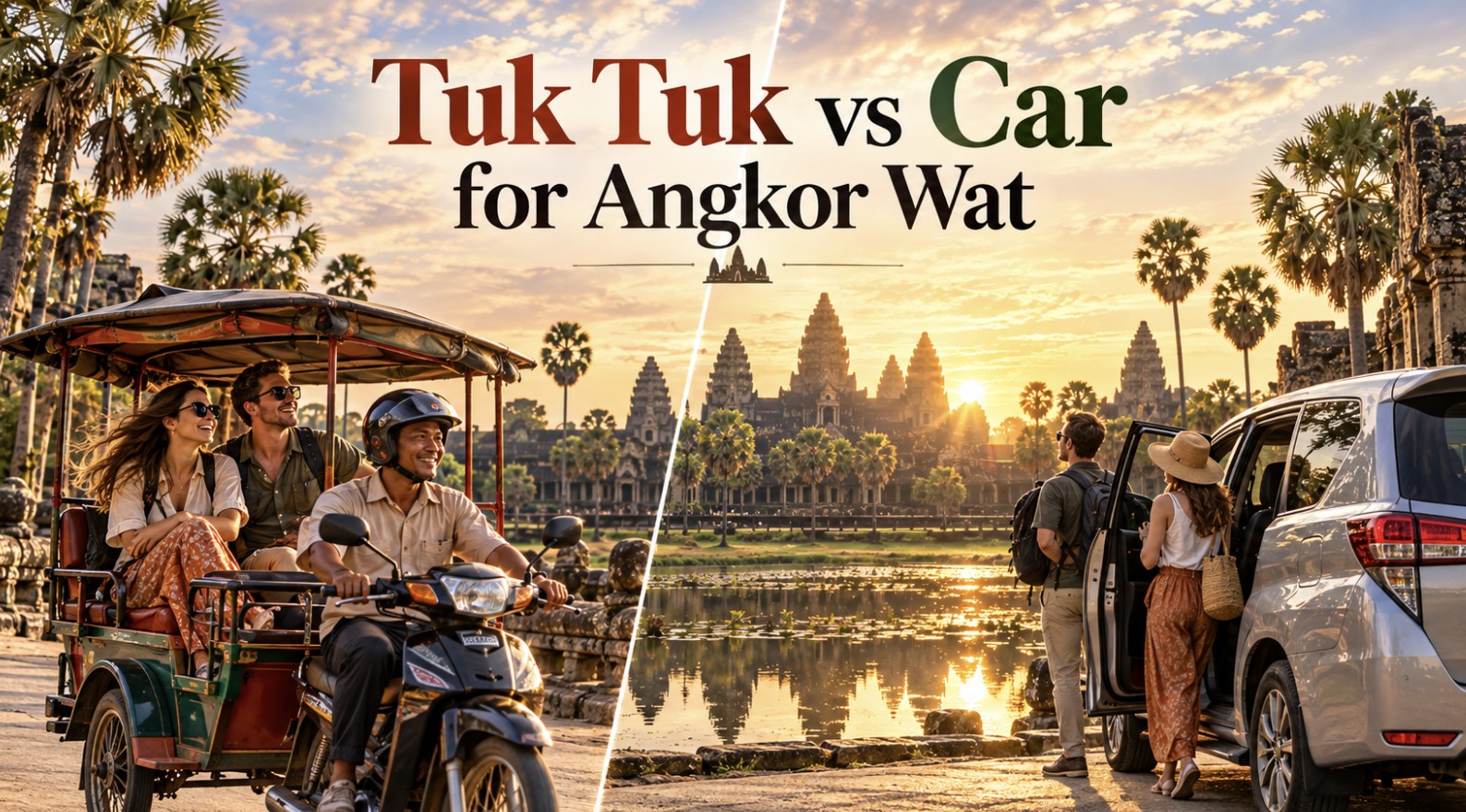
For most first-time visitors, both a tuk-tuk and a private car work well for Angkor. The better choice depends less on distance than on heat, comfort, budget, family needs and how far beyond the main temples you plan to go.
My short answer: for a normal Small Circuit or one-day Angkor visit, I would usually choose a tuk-tuk. For very hot weather, families, older travelers or longer routes such as Banteay Srei and outer temples, I would seriously consider a private car.
Tuk-tuk vs car for Angkor Wat at a glance
Tuk-tuk is usually the simpler and cheaper choice for the core Angkor circuits. You stay more connected to the landscape, stops are easy and it suits the short distances between many central temples. A private car costs more, but gives you air conditioning, better protection from dust or rain and a much more comfortable reset between longer temple walks.
Choose a tuk-tuk if you want the classic Angkor experience
There is a reason tuk-tuks are so common around Angkor: they fit the way most visitors move through the park. You leave your hotel, ride to the first temple, walk for an hour or more, then return to the same driver for the next stop.
For the Small Circuit, this works especially well because the main monuments are relatively close together. Angkor Wat, Angkor Thom, Bayon and Ta Prohm can all be handled comfortably without needing a car.
I also like the open-air feeling. You actually notice the roads, forest and changing atmosphere between temples rather than sitting inside an air-conditioned box all day.
Choose a car if comfort will change the quality of the day
A private car becomes more attractive when heat, fatigue or distance start affecting how much you enjoy the temples.
The biggest advantage is obvious: air conditioning. After forty-five minutes climbing stone stairs in the midday heat, ten minutes in a cool car can completely reset your energy. That matters more than people expect on a full temple day.
A car also gives you better protection from sudden rain, road dust and long exposed transfers. That becomes more useful on routes beyond the central park.
Tuk-tuk vs car for the Small Circuit
For the Small Circuit, I would usually choose a tuk-tuk unless someone in the group has a strong reason to prioritize comfort.
The route is compact enough that you are not spending hours on the road. The tuk-tuk waits while you visit each temple, and you can move easily between Angkor Wat, Angkor Thom, Bayon and Ta Prohm.
If this is your only temple day, our 1-day Angkor itinerary is built around exactly this kind of route.
Tuk-tuk vs car for the Grand Circuit
The Grand Circuit is longer, so the decision becomes more balanced.
A tuk-tuk still works perfectly well, and many travelers prefer it. But you spend more time between sites such as Preah Khan, Neak Pean, Ta Som, East Mebon and Pre Rup. In very hot weather, a car starts to feel less like a luxury and more like part of the pacing strategy.
For Banteay Srei and outer temples, I would lean toward a car
Banteay Srei is much farther from the core Angkor temples, which changes the calculation. A long tuk-tuk ride can be pleasant in mild weather, but in strong heat or rain I would rather have a car.
The same logic applies even more strongly to day trips involving Beng Mealea, Koh Ker or other distant sites. Once travel time becomes a major part of the day, comfort matters more.
See our Banteay Srei guide, Beng Mealea from Siem Reap and Koh Ker from Siem Reap if you are planning those routes.
Which is better for sunrise at Angkor Wat?
Both work well for sunrise. The main difference is comfort before and after dawn.
A tuk-tuk gives you the classic early-morning ride through cool air, which can actually be one of the nicest parts of the day. A car gives you a quieter, more comfortable start and becomes more appealing if you are carrying camera gear, traveling with children or planning a long route after sunrise.
If dawn is a priority, read our Angkor Wat sunrise guide before deciding on transport.
Which is better in the hot season?
Car wins on comfort, clearly.
In hotter months, the problem is not usually the drive itself. It is the accumulation of heat from walking, exposed stone, stairs and long temple visits. Air conditioning between stops can make the difference between finishing the day comfortably and feeling completely drained by early afternoon.
That said, if you are comfortable with heat and plan an early start plus a midday break, a tuk-tuk is still completely workable.
Which is better in rainy season?
A car gives you more reliable protection from sudden showers and keeps bags and camera equipment dry. A tuk-tuk usually has a roof and some side protection, but heavy rain can still make the ride less comfortable.
Rainy season does not automatically mean you need a car. If showers are light or intermittent, tuk-tuk travel can still be pleasant. Our Angkor rainy season guide explains the broader trade-offs.
Tuk-tuk vs car for families
For families with young children, I would often lean toward a car, especially on a full-day itinerary.
The reasons are simple: air conditioning, easier naps, less exposure to dust and weather, and more predictable comfort between temples. If the children are older and enjoy the open-air ride, tuk-tuk can still be fun and perfectly practical.
If you are traveling with kids, combine this with our Angkor with children guide and Siem Reap family guide.
Tuk-tuk vs car for older travelers
A car is often the safer comfort choice if anyone in the group is sensitive to heat, has reduced mobility or needs longer recovery between walks.
Angkor days involve more walking, uneven surfaces and stairs than the map suggests. Reducing transport fatigue can make the actual temple visits more enjoyable.
Tuk-tuk vs car for photographers
This depends on how much gear you carry and how long you want to stay at each location.
A tuk-tuk is flexible and easy for repeated stops, but a car gives better protection for cameras, lenses and bags during rain or dust. For sunrise and long photography days, that extra protection may justify the cost.
Our Angkor Wat photography guide goes deeper into light, timing and route planning.
What about luggage and bags?
For a normal day bag, either option is fine. If you are carrying expensive gear, extra clothing or several bags, a car is easier to secure and protect from weather.
I would not leave passports, large amounts of cash or irreplaceable valuables unattended in either vehicle while visiting a temple.
Which is cheaper?
A tuk-tuk is usually cheaper than a private car, but there is no single official universal rate for Angkor transport. Prices depend on route, distance, sunrise pickup, waiting time, outer temples and whether you book directly, through a hotel or through an agency.
That is why I would compare complete route quotes rather than ask only for a generic 'daily price'. Our Angkor tuk-tuk prices guide explains how drivers usually structure temple-day pricing without pretending there is one fixed tariff.
Do you need the same driver all day?
For Angkor, yes, I think that is usually the easiest arrangement.
The park is too spread out to treat every temple as a separate point-to-point ride. A dedicated driver waits outside each site and moves with you through the route. This is true whether you choose a tuk-tuk or car.
Driver vs guide: do not confuse the two
A driver handles transport. A licensed guide explains the temples and normally accompanies you inside them. Some bookings combine both, but you should confirm exactly what is included.
If you are deciding whether to add a guide, see our guided vs self-guided Angkor guide.
When I would choose a tuk-tuk
- You are doing the Small Circuit or a normal first-day Angkor route.
- You want the classic open-air experience.
- You are traveling solo or as a couple.
- You are comfortable with heat.
- You want to keep transport costs lower.
- You prefer easy stops and a more direct connection with the landscape.
When I would choose a private car
- You are traveling with young children or older relatives.
- You are visiting during very hot weather.
- You are doing Banteay Srei, Beng Mealea, Koh Ker or another longer route.
- You are carrying expensive camera gear.
- You want air conditioning between temples.
- You prefer more protection from rain, dust and road exposure.
My choice for a first visit
For a normal first day covering Angkor Wat, Angkor Thom, Bayon and Ta Prohm, I would choose a tuk-tuk. It is practical, flexible and part of the Siem Reap experience.
If I were traveling with children, someone sensitive to heat, or planning Banteay Srei or a long Grand Circuit day in the hottest months, I would switch to a car without overthinking it.
A simple decision rule
Small Circuit + normal weather + solo/couple: tuk-tuk. Long route + strong heat + family or comfort priority: car. If you are in between, choose based on how much air conditioning will improve the day for your group.
FAQ
Is a tuk-tuk safe for Angkor Wat?
Tuk-tuks are a standard form of tourist transport around Siem Reap and Angkor. As with any transport, use a reputable driver, agree the route and fare in advance and keep valuables with you.
Can a tuk-tuk do the Grand Circuit?
Yes. Tuk-tuks regularly do the Grand Circuit. The main question is comfort, especially in hot or wet weather.
Is a car necessary for Banteay Srei?
No. A tuk-tuk can do Banteay Srei, but the longer ride makes a car more attractive if comfort matters.
Is a car faster than a tuk-tuk around Angkor?
Usually somewhat, especially on longer road sections, but temple days are dominated by the time you spend walking inside the sites. The biggest benefit of a car is comfort rather than dramatic time savings.
Should I book transport before arriving in Siem Reap?
You do not need to arrange every ride before arrival, but I would organize the first major temple day in advance if you want sunrise, a specific route or a private car.
Keep planning your Angkor transport
Continue with our Angkor by tuk-tuk guide, Angkor by car guide, Angkor tuk-tuk prices, how to get to Angkor Wat, Siem Reap to Angkor Wat and our complete Angkor and Siem Reap guide.